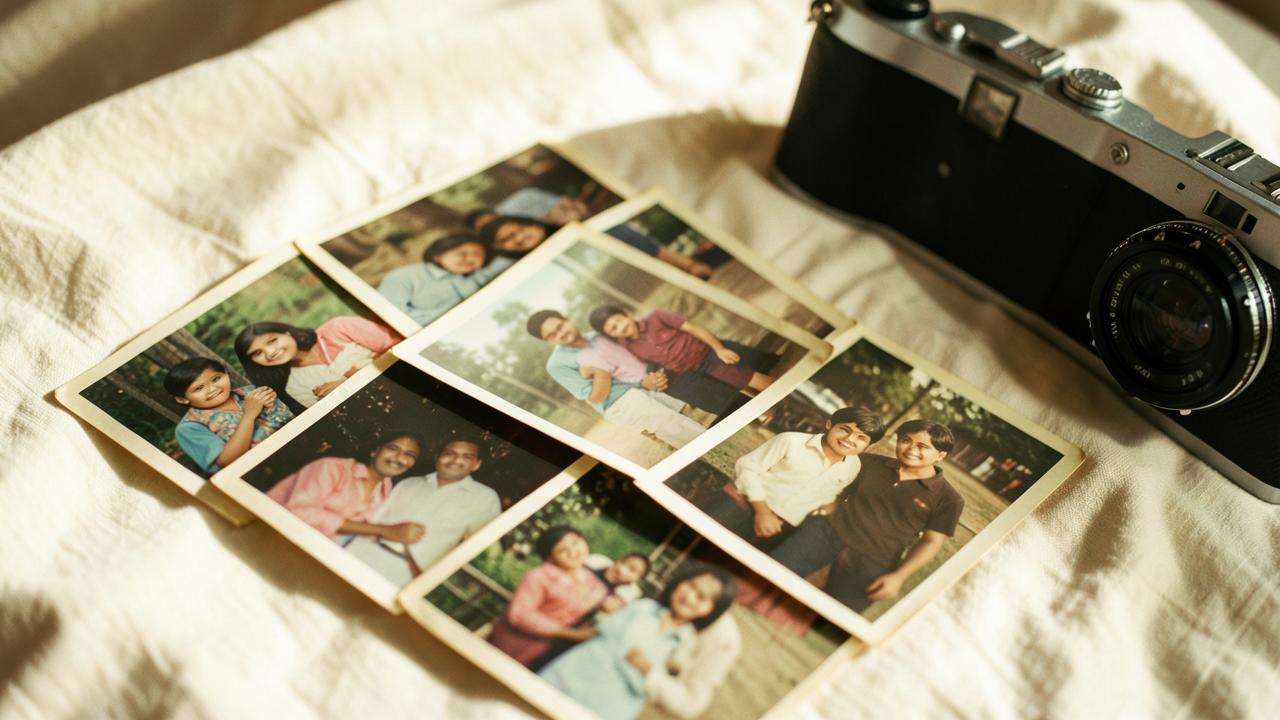
Go and count your photos from ages four to eleven.
If you were born somewhere between 1998 and 2006, the number is somewhere around forty. Maybe sixty. Your parents have more photographs of their own childhoods than you have of yours, which shouldn't be possible.
It's not that anyone was careless. You were born into a gap.
What actually happened
Before you: film. Expensive, limited, and deliberate. Thirty-six frames per roll, developed at a shop, arranged in an album. Your parents' childhood photos are few but they're curated, printed, and - crucially - they still physically exist.
During you: the transition. Film had become unfashionable. Digital cameras existed but were a Big Purchase, brought out for weddings and a Shimla trip, and the photos went onto a Windows XP desktop in a folder called "New Folder (2)".
That desktop was replaced in 2011. The photos were "backed up" onto a CD, or a hard disk that stopped spinning, or a Picasa account that no longer exists. Some of them went onto Orkut.
After you: smartphones. Kids born in 2012 have four thousand photographs of their first year. They will have the opposite problem - too much, no editing, which is its own kind of loss.
You got neither. You got the trough.
Why the ones you have are the ones you have
Notice what survived: the studio portraits. The passport photos. The framed one at your grandparents' house. The school annual day.
All printed. Everything that was only ever digital, from roughly 2003 to 2010, is gone - not deleted, just stranded on hardware nobody can read anymore.
The photos that survived your childhood survived because somebody paid to print them. That's the whole selection mechanism, and it has nothing to do with which moments mattered.
What to do about it, practically
Photograph the physical ones. This weekend.
Not scan - photograph. Take your phone to your parents' house, open the albums and the almirah, and shoot every page. Twenty minutes, natural light, no app.
The albums are ageing badly. The plastic sheets in 90s albums go yellow and stick to the prints, and pulling them out damages the photo. Whatever's in there is on a clock.
Ask about the hard disks
There is, in most Indian households, a drawer with a dead hard disk, two CDs, and a camera nobody has charged since 2009. Some of that is recoverable and nobody has ever checked.
Do it before your parents move house, which is when these drawers get emptied without ceremony.
Photograph your grandparents' walls
The framed portraits. The wedding photo. The village house. These are often the only copy in existence, and they're hanging on a wall in a room with sunlight.
And once you have them
Forty photographs is not a lot. It is also, it turns out, enough.
N° 01 · Living Portrait - ₹299. One photograph given movement - the framed one, the studio portrait, the single good picture of a grandparent. For photos from before video was common, this is the only moving image of that person that can ever exist.
N° 04 · Memory Film - ₹2,999. The forty, made into something. Small archives make good films, oddly - with four thousand photos the hard part is choosing. With forty, every single one earns its place.
Teaser in 24 hours, final piece in 2-3 days.
The point
You can't go back and take the photographs nobody took.
You can go and get the ones that exist off a shelf in Ghaziabad before the plastic finishes the job, and you can do it this weekend, and it costs nothing.
Photos storage hain. Stories memories hain.
SIYAI STORYKEEPERS
CTA block (soft):
N° 01 · Living Portrait ₹299 · N° 04 · Memory Film ₹2,999 Book on WhatsApp →