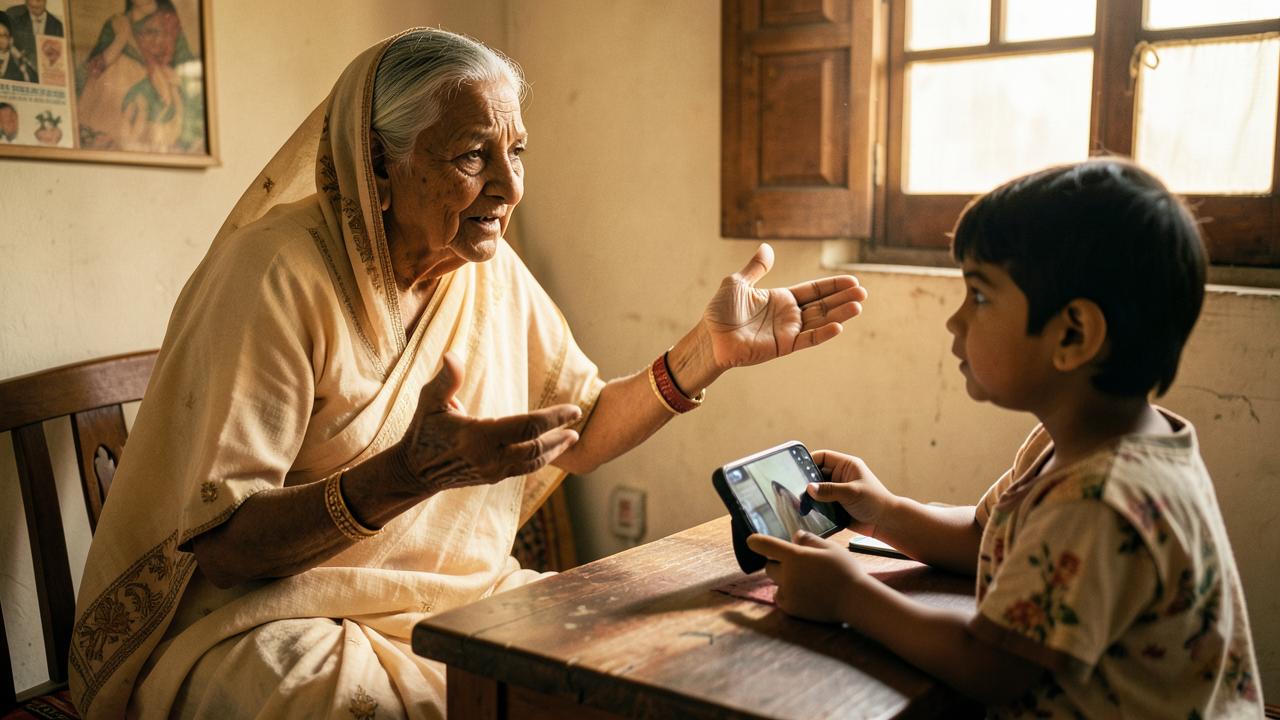
Here's a question worth sitting with for a second.
Do you have a recording of your grandfather's voice? Not a video with him somewhere in the background at a wedding. His voice, saying something, on purpose.
Most people don't. There's an entire generation of Indian grandparents whose stories were told at every dinner for forty years and written down never - and the loss is completely silent, because nobody notices the recording that doesn't exist.
This is a practical guide to fixing that. It costs nothing and it takes one afternoon.
Do it badly, this weekend
The most common reason this never happens is that people wait to do it properly. They plan to hire someone, or buy a microphone, or wait until the next family gathering when everyone's together.
Don't. A phone voice memo in a noisy room is infinitely better than a professional recording that never happens. Fan in the background, cooker going, someone's television - none of it matters. In twenty years you will not hear the noise. You will hear her.
Open the voice recorder on your phone, put it on the table, and don't make an occasion of it.
What to ask
This is the part people get wrong. "Tell me about your life" produces nothing - it's too big, and they'll say there's nothing to tell.
Ask small and specific. Specific questions unlock stories; general ones close them.
About the house
- What did your house sound like in the morning?
- Where did you sleep as a child? Who else was in the room?
- What did the kitchen smell like?
- Was there a shop nearby? Who ran it?
About their parents
- What did your mother's voice sound like?
- What did your father do when he was angry?
- What's a thing your parents said that you still hear?
- What did they want you to become?
About being young
- How old were you when you first earned money? What did you do with it?
- Who was your closest friend at twenty? What happened to them?
- What did you do on a Sunday?
- What's something you did that your parents never found out about?
About the marriage
- What do you remember about the day you got married - not the ceremony, the day?
- What did you think of them at first?
- What was the hardest year?
- What did you argue about?
About us
- What was my father like as a child?
- What was I like as a baby?
- What do you want us to remember?
That last one usually ends the conversation, so save it for the end. It also tends to produce the answer you'll keep.
A few things that help
Ask about objects. Hand them a photograph, a piece of jewellery, a utensil. Memory attaches to things far better than to dates.
Let the silences run. The instinct is to fill a pause with the next question. Don't. The thing they say after eight seconds of silence is usually the thing you came for.
Don't correct them. If the year is wrong or the story contradicts what your father says, leave it. You're recording a person, not compiling a record.
Record more than once. The first twenty minutes are performance. The second sitting is where they forget the phone is there.
Ask them to sing something. Almost nobody does this and it is the recording families end up treasuring most.
What to do with it afterwards
Most of these recordings die on a phone that gets replaced.
Immediately: email the file to yourself and put it in cloud storage. Two places, today. Label it: name, date, what's on it. In twenty years "Voice 047.m4a" is not findable. Share it: send it to the family group. Your cousins do not have this and will not think to make it. Transcribe it: any free transcription tool. Names of villages and relatives are easy to mishear later.
And if you're too late
Some people reading this don't have the option. The recordings weren't made and now can't be.
What usually survives is photographs. Sometimes only one - the framed portrait, photocopied so many times the face has gone soft.
N° 01 · Living Portrait - ₹299 brings a single photograph to life. It doesn't replace a voice and we won't pretend it does. But for a lot of families it's the only moving image of someone that will ever exist.
And if what you're carrying is something you never got to say to them, that's what N° 02 · Voice Letter - ₹499 is for. You record it. We make it into something finished, something that exists outside your head.
"Mummy ne jaise hi Nani ki awaaz suni... woh kuch der tak kuch bol hi nahi paayi. Uske baad bas baar-baar sunti rahi."
- Priya S., Mumbai · gifted her mother a Voice Letter in Nani's voice
The point
Photos storage hain. Stories memories hain.
A photograph tells you what someone looked like. Only a story tells you who they were, and stories only survive if somebody bothers to catch them.
Your grandmother is going to tell the same story at dinner this weekend that she has told a hundred times. This time, put your phone on the table.
SIYAI STORYKEEPERS A gift today. A memory forever.
CTA block (soft - this page does not hard-sell):
Made a recording and want it turned into something? Book on WhatsApp → Teaser in 24 hours · 3,753+ memories made